Getting started
Getting Started
Essential Basic Concepts
Before moving on to installing the terminal and placing your first trades, it's important to understand a few key concepts of crypto trading. This foundational knowledge will help you make sense of what’s happening on the market and what actions you’re performing in the Moonbot terminal.
Cryptocurrency Market
The cryptocurrency market is a global marketplace where people buy and sell cryptocurrencies through exchanges. Unlike traditional stock markets, the crypto market operates 24/7 with no breaks — prices can change at any time.
The price of a cryptocurrency is determined by supply and demand:
-
When there are more buyers — the price goes up
-
When there are more sellers — the price goes down.
Market Participants
The crypto market isn’t just about charts and prices — behind every price movement are real participants making decisions to buy or sell.
A trader is a market participant who places trades with the goal of profiting from price changes. Traders analyze the market, make decisions about when to enter and exit trades, and use tools like the Moonbot terminal to execute those decisions.
In addition to traders, the market also includes:
As a Moonbot user, it's important to understand that you are acting in the role of a trader — making your own decisions — and the terminal is simply a tool that helps you execute those actions quickly and efficiently.
Trading Pair
On an exchange, you don’t trade a single cryptocurrency — you trade a pair, such as BTC/USDT:
The trading pair’s price shows how many units of the second currency are needed to buy one unit of the first.
For example, if the Moonbot terminal shows BTC/USDT = 90,000, it means:
-
You can buy 1 BTC for 90,000 USDT
Or
-
You can sell 1 BTC and receive 90,000 USDT.
Simply put, when trading, you're exchanging one currency for another at the current market rate. In the Moonbot terminal, all buy and sell operations are executed within the context of the selected trading pair.
Long and Short: Buy and Sell
The core action a trader performs in crypto trading is placing a trade — an operation aimed at making a profit. A trade means a sequence where you first enter the market and later exit, locking in either a profit or a loss.
Before entering a trade, the trader must determine in which direction they expect the cryptocurrency price to move — up or down. Based on this expectation, one of two basic actions is performed: buying or selling the cryptocurrency.
In crypto trading, trades are commonly categorized by direction:
For beginners, we recommend starting with long trades, as they are more intuitive and easier to understand. Short trades involve additional risks and are more suitable for users with some trading experience and familiarity with the Moonbot terminal.
Order
An order is a command sent to the exchange to buy or sell a specific cryptocurrency within a chosen trading pair. For example, in the trading pair BTC/USDT a buy order means you're purchasing BTC using USDT and a sell order means you're selling BTC to receive USDT. When an order is executed, it results in an actual buy or sell transaction based on the parameters you’ve specified.
In Moonbot, orders are used to open and close trades: they allow you to enter the market and later exit, locking in the result of the trade.
To start trading, it's enough to know the two main types of orders:
We recommend using market and limit orders with small amounts at first. This lets you safely explore how trades are opened and closed in Moonbot — and avoid major losses while you're learning.
Sudden Price Movements: Pump and Dump
On the crypto market, sharp and rapid price movements happen from time to time:
During such events, the market becomes especially emotional — prices may change in seconds, and decisions have to be made under pressure. Beginners often make mistakes by entering trades too late (chasing the hype) or exiting positions in panic during a sharp drop.
At the early stages, we recommend avoiding trades during extreme price swings. Focus instead on calmly learning the trading process and how to use the Moonbot terminal. This will help you avoid impulsive actions and unnecessary losses.
Choosing a Coin for Your First Trades
Before placing your first trade, you’ll need to choose a cryptocurrency to work with. This choice affects how easy it will be to trade — and what level of risk you’ll face.
We recommend starting with well-known, high-volume cryptocurrencies actively traded by many market participants. For example: BTC/USDT, ETH/USDT, BNB/USDT, SOL/USDT, XRP/USDT. These pairs have strong liquidity, meaning there are always buyers and sellers available. As a result, trades are executed quickly, and the price movements tend to be smoother and more predictable — ideal conditions for your first steps in crypto trading.
Now that you're familiar with the minimum essential concepts, you're ready to move on to the next stage.
These basic terms will help you better understand how the crypto market works — and trade more consciously in Moonbot.
📘Recommended learning:
In the next section, we’ll cover the fundamentals of risk management — simple but critical rules that help you reduce risks and avoid common beginner mistakes.
Basic Risk Management for Beginners
Risk management is a set of simple rules that help control losses and protect your capital while trading. At the early stage, the lack of risk management is one of the most common reasons for serious losses — even when the market direction was predicted correctly. That’s why it’s important to understand and apply basic risk management principles before you start trading actively in the Moonbot terminal.
Key Principles of Risk Management
Risk management in crypto trading exists to ensure that individual mistakes don’t result in major losses. Even if your market forecast turns out to be wrong, you shouldn’t be forced out of trading entirely.
Here are the key principles:
Each trade should use only a portion of your funds. This way, you can recover from a loss without severe consequences and continue trading confidently.
Before entering a trade, you should know how much loss you’re willing to tolerate. Clear loss limits help protect your capital and reduce emotional pressure.
A stop-loss automatically closes your position when a certain loss threshold is reached. It enforces your pre-set risk limits and helps avoid emotional decisions during sharp price moves.
Early on, your main goal is to understand how trading works and how to use the Moonbot terminal — not to make fast profits. Small trades allow you to learn without unnecessary stress or financial risk.
After a losing trade, it’s important to stay disciplined. Avoid increasing risk in an attempt to "win back" losses — this often leads to a string of poor decisions.
Fear, greed, and excitement are part of trading, especially at the beginning. Clear and simple rules help reduce the impact of emotions on your decisions.
Practical Tip for Getting Started
Begin with the smallest possible trade sizes and set a risk limit for each trade in advance. Focus on learning the process and mastering the Moonbot terminal — not on making a profit right away. This approach allows you to gain confidence, avoid beginner mistakes, and build trading discipline step by step.
Полное руководство по функциям, настройкам и стратегиямKeeping these principles from day one won’t guarantee profits — but it will help you avoid major losses and develop a calm, disciplined trading mindset.
📘Recommended learning
Summary: Getting Started
In this section, you’ve learned the core concepts of crypto trading and the minimum set of terms needed to begin working with the market and the Moonbot terminal. We covered the key components of the trading process, as well as the basic risk management rules every beginner should follow.
Understanding these fundamentals will help you trade more consciously, avoid common pitfalls, and build a solid and safe trading approach.
📺 Training Videos
To reinforce what you’ve learned and prepare for hands-on trading in Moonbot, we recommend watching these video tutorials:
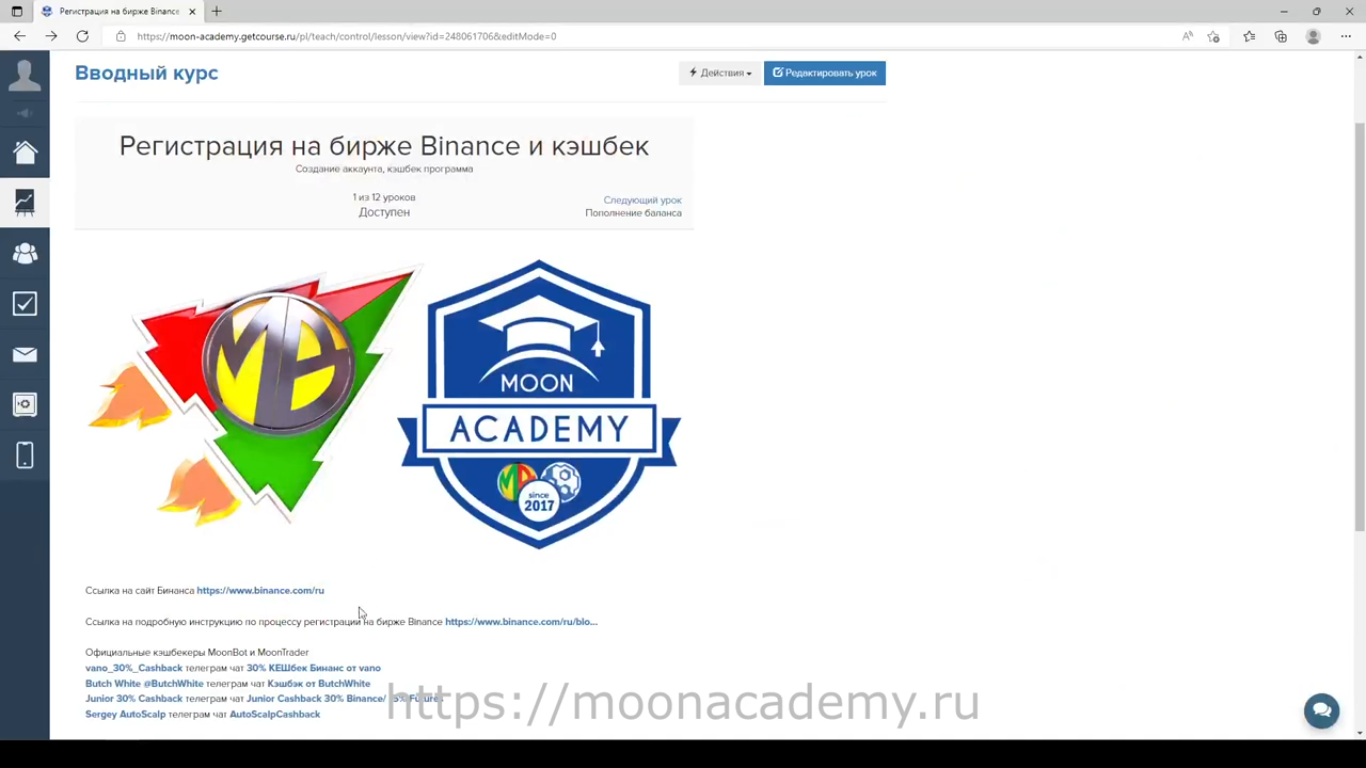
📹 01 — Registering on Binance for use with the Moonbot terminal